
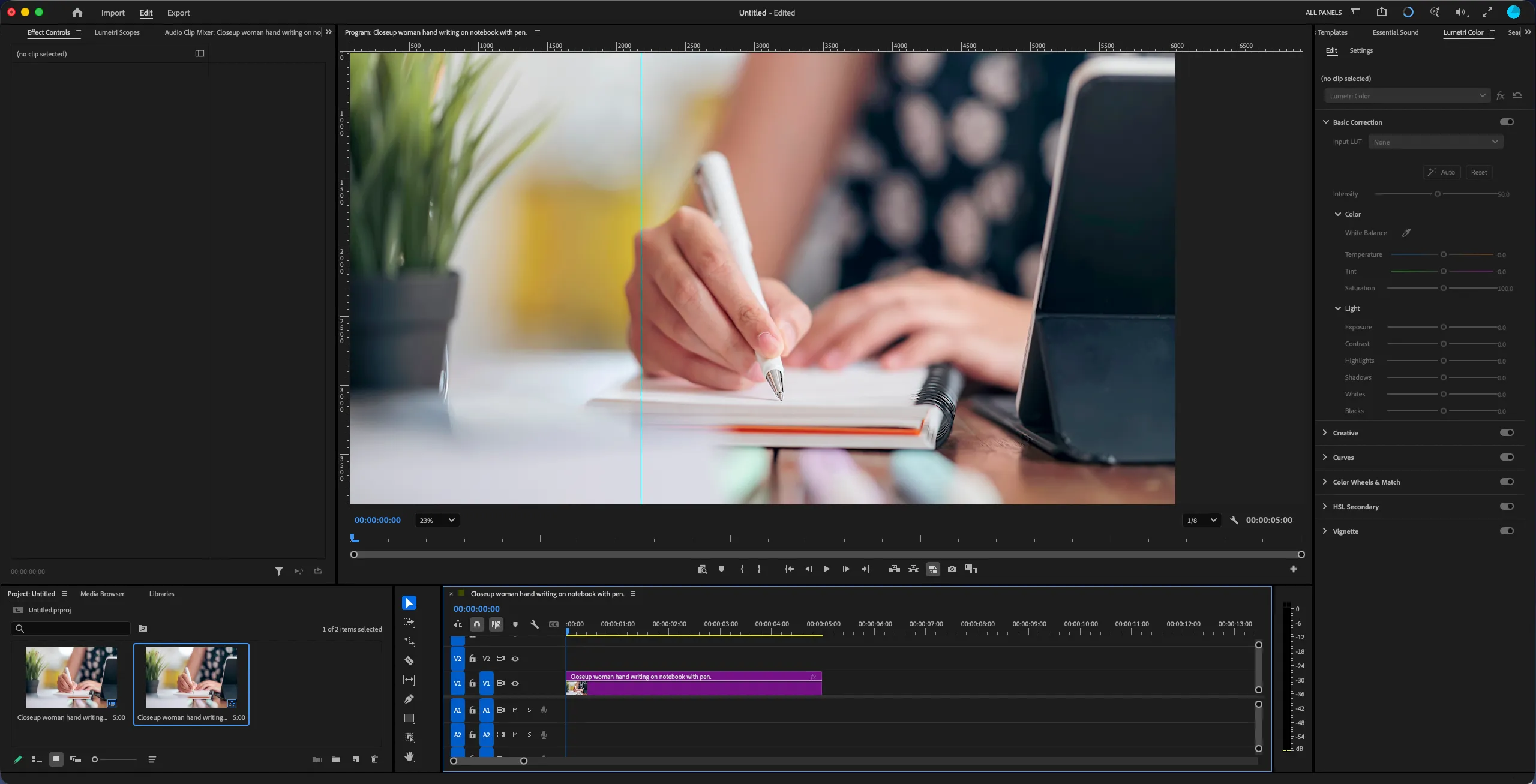
Video editing is now going to be more led by writers.
I say this because, as a corporate photographer and videographer in Bangalore, I get a chance to work with large companies and multinational companies. At the same time, I also get a chance to hire photographers and videographers for different projects.
And there is something I keep noticing when I look at videography portfolios.
What does “cinematic” actually mean?
When I ask videographers to send their portfolios, especially when they describe their work as “cinematic”, what I frequently see can be summed up in two things.
Slow gimbal shots.
And randomly placed shots.
That’s it.
Can you see the difference?
What’s missing here?
The storyline.
I got to the idea that cinematic, in the mind of many videographers, has become this combination of slow gimbal shots, slow music and nice looking footage.
And then we call it cinematic.
But as corporate photographers and videographers, we are here to tell a story.
Slow music and slow shots by themselves are not telling any story.
Who is the video actually for?
This is where I think we need to ask a very simple question.
If an event company or a brand hires you to make a video, are they hiring you to promote the photographer or videographer?
Or are they hiring you to promote their brand?
Because these are two very different things.
If I am showing off my camera movement, my gimbal work, my transitions and all the other things I can do as a videographer, I might be making a video that looks good.
But does it do anything for the brand?
That’s the question.
When we try to find the answer to that question, we come to the idea that we need to be less focused on ourselves and more focused on the brand.
And that’s where the story comes into the picture.
What does a brand actually want from a corporate video?
Let’s take a simple example.
A company is launching a new office in Bangalore.
They don’t just want us to show the building.
They don’t just want shots of people walking around.
They don’t just want a slow gimbal shot through the office with some slow music.
They want to communicate something.
Why was this office important?
Why Bangalore?
Why did they build it?
How is it different?
What does this mean for the company?
And how does the future look?
That’s the story.
The job of corporate video production is not just to show what happened.
It is to communicate why it mattered.
This is where writers come into video editing
And this is why I think writers are going to become much more important in video editing in 2027 and the years ahead.
Writers understand structure.
They understand how to take different points and build them into a story.
Any random person, when we ask them to tell a story, might start from point A, then B, then C, then D, and continue until Z.
A writer thinks differently.
They pick the point, the valley, the path, the mountain.
They build a story.
And that structure can be directly utilized in video editing.
Because the goals are actually very similar.
An editor has hundreds of clips. What happens next?
Think about a corporate event.
After shooting, we might have hundreds of clips.
Two hundred clips.
Maybe even more.
Sometimes there is a voiceover.
Sometimes there isn’t.
But even without a voiceover, there is still a story that can be told through the footage.
The question is not simply:
Which clip comes next?
The question is:
What does the audience need to understand next?
That is where pacing comes in.
That is where structure comes in.
That is where storytelling comes in.
And I think this is something video editing has traditionally not focused enough on.
Video editors have traditionally been very focused on the edit itself.
Cuts.
Transitions.
Effects.
Music.
Color.
And all of these things are useful.
But they are tools.
They are not the story.
The era of “slow gimbal shots = cinematic” is changing
I have seen thousands of videos made in this style.
Slow gimbal shots.
Slow motion.
Nice music.
AI generated 3D animated elements.
Beautiful transitions.
And then the video is called cinematic.
But what is it actually saying?
If all of those elements are not helping the brand communicate something, then what value are they adding?
This is where I think the industry is going to change.
The era of simply making a video look cinematic without thinking about the story is going to become less valuable.
The tools will continue to change.
AI will continue to change video production.
Editing software will become more powerful.
Cameras will become better.
But the need for a good story isn’t going away.
If anything, it is going to become more important.
What we are doing at AEP Media
In my agency, AEP Media, I am definitely going in this direction, and I am seeing the market react to it.
We are one of the top corporate videography agencies in Bangalore.
Clients are loving it.
Our videos are creating an impact.
And this is the direction I want to continue building in.
I don’t want our videos to simply show that we know how to operate a camera or edit footage.
I want the video to do something for the brand.
That could be explaining why a new office was launched.
It could be showing why an event mattered.
It could be explaining a product.
It could be showing the people behind a company.
Whatever the subject is, there has to be a reason why the audience should watch it.
And that’s where storytelling becomes important.
What this means for video editors
I don’t think writers are going to replace video editors.
That’s not what I am saying.
I think video editors who understand storytelling are going to become more valuable.
And writers who understand video are going to have a very interesting opportunity.
Because when you combine writing, structure, pacing and visual storytelling, you get something much more powerful than just a collection of good looking shots.
You get a video that actually communicates something.
And I think that’s where corporate video editing is going.
Not away from good visuals.
But away from visuals that exist only for the sake of looking good.
The question is no longer just:
“Does this shot look cinematic?”
The more important question is:
“Does this shot help tell the story?”
That’s the shift I am seeing.
And that’s the direction I am taking AEP Media in.